


GUIDES
Cognitive Learning: Benefits, strategies and examples
Help your employees become exceptional.
Cognitive learning can help transform the way your business approaches corporate L&D, and this article will help you understand what it is and how you can implement strategies into your training, so that you can maximize the potential of your most important asset: your people.
What is cognitive learning in psychology
- Cognition: Describes the brain’s process of acquiring and retaining knowledge.
- Cognitive learning: Is an active psychological practice that helps you maximize your brain’s ability and enhance the way you learn. It is a branch of psychology that studies the brain’s processes and methods in which to strengthen them.
How can cognitive learning help my business?
Employees that have strong cognitive skills are able to acquire, retain and process information at a greater rate.
This can boost the output of your company considerably, as employees will be able to work through tasks quickly and effectively. It is imperative that you continually expose them to ways in which they can improve their cognitive learning.
Components of cognitive learning
Cognitive learning is split into 3 parts:
- Comprehension
- Memory
- Application
Where traditional learning focuses a lot on memory (studying for a test for example), cognitive learning instead focuses on the complete mastery of a topic or skill. It focuses on not simply understanding information – but retaining and, importantly, applying it in a practical way.
1. Comprehension
Comprehension is the gaining an understanding of what you are learning and why you are learning it. This is crucial to effective cognitive learning.
2. Memory
Having a deep understanding of what you are learning greatly improves your ability to retain the information and apply it elsewhere. Cognitive learning rejects the cramming of information, favoring a more bitesize approach to learning.
3. Application
Cognitive learning gives you more than the ability to retain and regurgitate information. It allows you to apply what you learn to various situations, maximizing your learning experience.
Cognitive learning theories
Whilst breaking down the process of learning, cognitive learning theory looks at what factors have an influence on our cognitive ability.
These factors can be both internal and external factors. From these, two branches of cognitive learning theory have been created: social cognitive theory and cognitive behavioral theory.
Social cognitive theory
- External factors will influence how someone learns
- Usually associated with observational learning or learning from your environment
Cognitive behavioral theory
- Internal factors will influence how someone learns – mental processes, thoughts and emotions
- Internal factors are viewed as links in a chain, suggesting that your thoughts and emotions can influence behavior and outcomes
Benefits of cognitive learning
Cognitive learning theory will stimulate the growth of your employees and maximize their potential.
When the opportunity to learn comes about, they will be able to apply the theory and enhance their learning experience.
Employees will be able to tackle new challenges with confidence that they have the frameworks to understand and apply what they learn.
As confidence grows, so will motivation, and motivated employees are also more productive.
Once employees master the process of cognitive learning they will be able to acquire knowledge at a much improved rate.
This is because cognitive learning theory attaches new information to old information and stores it into long term memory, whereas standard learning requires repetition for memorization, a process which takes more time.
Problem solving is a cognitive skill, and the cognitive learning theory encourages employees to hone those skills.
When faced with a challenging task, they will be better equipped to reach a solution.
The process of cognitive learning encourages employees to gain a deeper understanding of learning material.
This makes the learning experience more effective, as the new information can be better applied, and the need to re-learn will be less likely.
Cognitive learning allows employees to have greater levels of comprehension.
This means when they are learning how to do their job, they will be able to see any potential flaws or avenues for improvement.
This will encourage employees to be more innovative and look for ways in which to make your business more efficient.
Cognitive learning strategies
There are 4 cognitive learning strategies created by psychologists that can be implemented in a working environment:
- Learner-centered strategy
- Meaningful experiences strategy
- Learning through discovery strategy
- Personalized learning strategy
Learner-centered strategy
Developed by Jean Piaget, this strategy does as the name suggests; putting the learner at the center of the learning process.
He believes that learning is linking new information to the learner’s pre-existing knowledge. According to Piaget, there are three components to learning:
- Accommodation: Making room for new information
- Assimilation: Arranging this new information alongside pre-existing knowledge
- Equilibration: Balancing the new information and the pre-existing knowledge
Here are some key points to take from this strategy when building a L&D program:
Develop programs based on the employees pre-existing knowledge – this could look like simulated environments, systems or processes for example.
Link any new information back to the pre-existing knowledge – think of this as ‘knowledge stacking’.
Learning through discovery strategy
Built on Piaget’s learner-centered approach, Jerome Bruner developed the learning through discovery strategy.
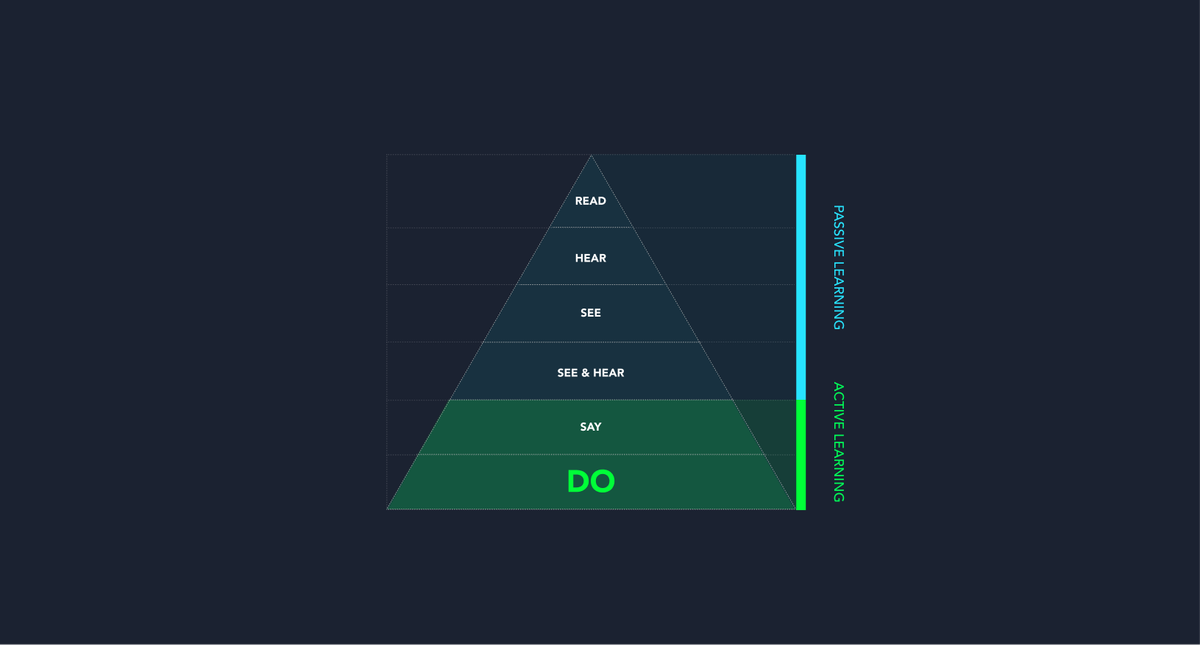
Bruner’s theory suggests that the most effective way of learning is through doing (we’d be inclined to agree). The learner, armed with their pre-existing knowledge, navigates their way through problems and discovers new information along the way.
This way of learning promotes employee engagement, and the autonomous aspect can lead to improved problem solving skills.
Consider these points when building an L&D program:
The program should simply be a guide to employees, putting them in situations where they can discover their own solutions to tasks – examples include problem based learning and simulation-based learning.
Challenge employees to complete tasks that are real problems faced by the comp.
Personalized learning strategy
These strategies all point to a personalized method of learning. Each employee has their own strengths and weaknesses, and a generalized L&D program is an ineffective way to maximize your workforce potential.
A learning process that is centered around the student has been found to be more effective in maximizing their levels of achievement.
Modern technology can provide the learning environment that companies look for. For example, simulation based learning allows employees to experiment with different solutions to problems, without any real-world consequences. They can then apply what they’ve learnt in the real world.
Cognitive learning examples
Every type of cognitive learning can be an effective way to learn in the workplace. When building an L&D program, it is important to know the solutions that will have the most positive effect upon your employees.
Participants will consciously seek out new information or to develop a new skill. This requires your teams to play an active role in their learning.
This is a passive process, and happens subconsciously. This type of learning can occur at any time, and awareness of the process only comes when you put what you learn into practice.
Learning to talk is a good example of implicit learning. You may be able to pinpoint your first words, but the nature of the process makes it hard to tell when you became fluent.
Meaningful learning is when you relate new information to past experiences. This helps you apply existing skills to new problems.
An example of meaningful learning is taking an advanced course in something you’re already proficient in and linking the new information to what you already know.
Discovery learning is an active process that occurs when researching new processes, concepts or subjects.
For example, someone may use a thesaurus to give a piece of writing more variety, and through that discover new synonyms and antonyms they didn’t previously know.
Learners are given new information through a lecture, video or demonstration. This type of learning requires an engaged and attentive learner, who is focused on the new information.
It can be a pretty passive way of learning new information and doesn’t always prove effective when it comes to knowledge retention.
This happens through consistent exposure to a situation, and can be split into two categories: habituation and sensitization.
When first moving to a larger office, the increased noise levels could be distracting. However, after continuous exposure, you learn to tune it out. This is called habituation.
Sensitization is when continuous exposure brings out a reaction, rather than stifles one. For example, the first time you work in an office, the ring of a telephone may bring no immediate reaction. Over time, you will learn to react more instinctively.
Emotional intelligence is integral to relationships both in and out of the workplace. It is important to understand and control your own emotions, but also to understand others.
Employee’s need to be emotionally intelligent to have good relationships with customers, colleagues and superiors.
This is learning through life experiences.
Every interaction in life can be a lesson, and the most important component of this type of learning is how you interpret new information. It’s vital that the learner sees interactions as opportunities to learn.
This is when the learner observes those around them and imitates positive behaviors.
This is particularly effective in the workplace, as employees can observe the way others around them act.
This is when employees work and learn in teams; effective in strengthening social skills. Teams can then learn from one another’s strengths. Studies have shown that feeling less isolated in work can improve productivity by 21%2.
For this to be truly effective, individual employees need to play an active role in the team, and not shy away from participating.
Every type of cognitive learning can be an effective way to learn in the workplace. When building an L&D program, it is important to know the solutions that will have the most positive effect upon your employees.
Discover more on modern L&D solutions with Attensi.
Are you ready to level up your training?



Sources
- Effects of learner-centred education on academic achievement: a meta-analysis, tandfonline.com/doi/abs/10.1080/03055698.2021.1940874
- Lead Your Remote Team Away From Burnout, Not Toward It, gallup.com/workplace/312683/lead-remote-team-away-burnout-not-toward.aspx