




INSIGHTS
Gamification vs. Game-Based training
Learn how traditional gamification differs to modern game-based training and why this distinction matters in L&D.
The rapid advance of technology is changing the goal posts in most industry sectors. Embracing the opportunities that advancing technologies can bring to training and development is vital to stay ahead of the competition in an era of unprecedented change.
This is one of the reasons why it is becoming increasingly important to recognize the distinction between gamified learning – a relatively old concept with a very wide scope for interpretation – and game-based training – a more recent term that refers specifically to training designed using video gaming technologies, simulations, gaming mechanics and most recently of all, generative AI features.
Gamification
Applies game techniques to already existing, more traditional learning methods. It does not resemble a video gaming experience.
Game-based training
Is designed from its foundations up to achieve targeted learning outcomes through gameplay.
Spot the difference
Gamification
'Gamifying' is a vague and widely applicable term. Perhaps the most useful distinction to begin with is that to gamify a learning technique is to apply game methods to already existing learning methods.
You can gamify learning by adding something as basic as a points system and a scoreboard for example. You 'play' a part in a role play which can also be classed as a gamification method of sorts in comparison to reading a textbook, watching videos, or attending a seminar.
E-learning can be gamified, but it will likely look and feel very different to 'gaming' as a gamer knows it - using the design mechanisms and narrative techniques that expert game designers have at their disposal to create games from the foundation up.
Of course, all these learning techniques have value. Game-style elements can be incorporated successfully to improve learning experiences and outcomes in many traditional learning environments.
A great teacher may achieve improved results by engaging children with games in the classroom for example. A great trainer might be very engaging in leading well-designed role-plays. But the success is likely to be determined by the talents of the individual and therefore, although there may be best practice take-aways, the solution is not necessarily scalable or even replicable. It is also restricted by physical time and space.
Game-based training
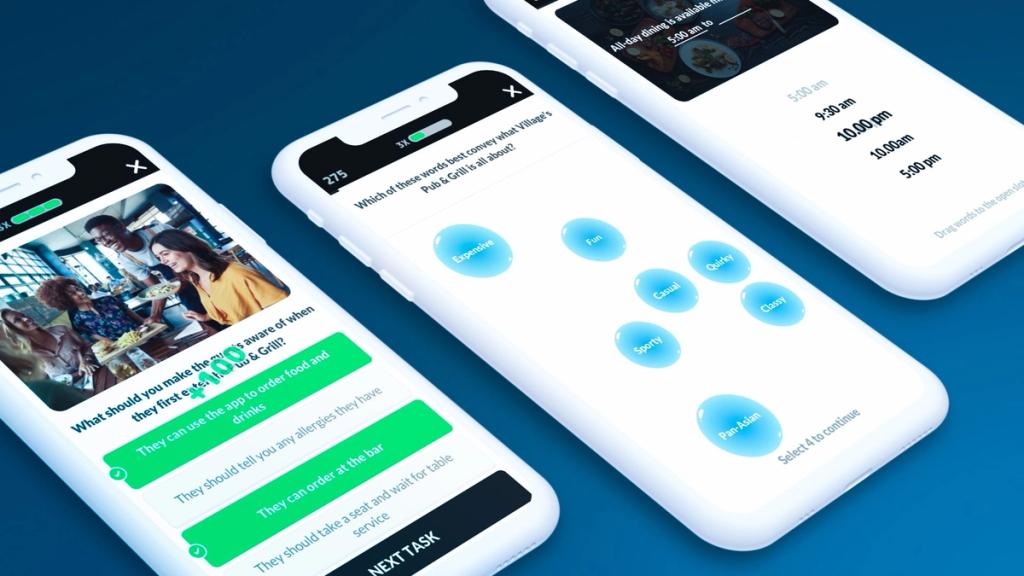
When we talk about game-based training we are talking specifically about video games designed for workplace training and development. They use the same game mechanics as game designers use for box office games that are top of the gaming charts around the world.
These games range from multi-device mini games that resemble games you would download from an app store to fully immersive reality scenarios using VR headsets or glasses. Most commonly however, game-based training solutions tend to include a combination of bite-sized mini-games and realistic simulations using avatars as well as simulated processes and systems.
Compared to gamification, game-based training is a relatively young term in the Learning and Development space. There is a growing sector of the industry that specializes in the field of video game design for workplace training, behavior change and learning and development solutions. Game-based training has enjoyed huge growth in the market over the last decade. The global game-based learning market size reached US$ 18.4 billion in 2023, and industry analysts predicts a compound annual growth rate (CAGR) of 15.8% during 2024 – 2032.1
Companies that specialize in game-based training, like Attensi, combine three areas of expertise:
Video game development and design
Psychology and human behavior
Learning and development
It is a multilayered arena of expertise.
1. Video game development and design
Video game development and design are fundamental components of game-based training, distinguishing it from traditional gamification methods. Unlike gamification, which applies game elements to existing learning platforms, game-based training involves the creation of custom-designed video games tailored to specific learning objectives.
Expertise in video game development and design is essential for crafting immersive and engaging training experiences. Game designers utilize advanced graphics, interactive interfaces, and storytelling techniques to captivate learners' attention. From character design to level progression, every aspect of the game is meticulously crafted to facilitate learning and skill acquisition.
Moreover, video game development incorporates cutting-edge technologies such as virtual reality (VR) and augmented reality (AR) to create realistic simulations. These immersive environments provide learners with hands-on experience in complex scenarios, enhancing knowledge retention and transferability to real-world situations.
By harnessing the power of video game development and design, game-based training offers a dynamic and interactive learning experience that resonates with modern learners. Companies like Attensi leverage their expertise in game development to create innovative training solutions that address the evolving needs of organizations.
2. Psychology and human behavior
Incorporating psychological principles into game-based training is crucial for maximizing engagement and knowledge retention. Game designers utilize insights from cognitive psychology to create experiences that resonate with learners on a deeper level. For instance, by leveraging principles of operant conditioning, such as reward schedules and reinforcement, game-based training motivates learners to actively participate and progress through challenges.
Moreover, understanding the psychology of motivation and behavior enables developers to design effective feedback systems. By providing timely and meaningful feedback, game-based training cultivates a sense of accomplishment and progress, encouraging learners to persist in their efforts. Additionally, incorporating elements of social psychology, such as collaboration and competition, fosters a sense of community and camaraderie among learners, enhancing engagement and retention.
By applying psychological principles to game design, game-based training creates a dynamic and immersive learning environment that captivates learners' attention and drives meaningful behavior change.
3. Learning and development
In the realm of learning and development, game-based training offers a transformative approach to skill acquisition and behavior change. Unlike traditional training methods, which often rely on passive instruction, game-based training promotes active learning through experiential gameplay. By immersing learners in realistic scenarios and challenges, game-based training facilitates skill transferability to real-world contexts.
Furthermore, game-based training embraces principles of adult learning theory, such as self-directed learning and relevance to learners' needs. By allowing learners to explore concepts at their own pace and providing opportunities for application and reflection, game-based training empowers individuals to take ownership of their learning journey.
Moreover, game-based training fosters a growth mindset by encouraging experimentation and learning from failure. Through iterative gameplay and adaptive difficulty levels, learners develop resilience and problem-solving skills, essential for success in today's fast-paced work environment.
By integrating learning and development principles into game design, game-based training offers a scalable and effective solution for organizational training needs. Whether it's onboarding new employees or upskilling existing workforce, game-based training provides a dynamic and engaging learning experience that drives performance and innovation.
Attensi's approach
Attensi specializes in game-based training solutions that integrate video game development, psychology, and L&D principles. With a focus on creating immersive and effective training experiences, Attensi combines cutting-edge technology with pedagogical expertise to deliver measurable results.
By partnering with Attensi, organizations gain access to customized training modules designed to address their specific learning objectives. Whether it's onboarding new employees, developing leadership skills, or enhancing product knowledge, Attensi's game-based training solutions offer a scalable and engaging approach to workforce development.
Attensi CREATOR puts the power of game-based content creation in your hands - now with AI co-pilot tools, AI powered translations and AI voice-over facilities.
Through a combination of gamification techniques and video game design principles, Attensi empowers learners to actively participate in their own learning journey. By immersing them in realistic scenarios and providing immediate feedback, Attensi's training foster skill acquisition and behavioral change.
In conclusion, while both gamification and game-based training aim to enhance learning and development, the distinction lies in their approach and methodology. Gamification supplements existing learning methods with game elements, whereas game-based training leverages video game design principles to create immersive and effective training experiences. With Attensi's help, organizations can unlock the full potential of game-based training to drive performance and innovation.
Are you ready to level up your training?



Sources
- Game-Based Learning Market Report by Platform, imarcgroup.com/game-based-learning-market